-
Analysis of US suitability for natural gas power with CCS
Date posted:
-
-
-
Post Author
Greg Kelsall
-
-
![]()
A new national atlas from Great Plains Institute has provided a comprehensive analysis of the suitability of areas across the United States to support natural gas-fired power generation with carbon capture and storage (NG + CCS).
After decades of relatively stable electricity demand, US consumption is projected to grow 35-50% by 2040, according to a recent study by American Clean Power. The growth is largely driven by artificial intelligence, data centres, and the electrification of industry and transportation. Achieving this, while ensuring reliability and reducing emissions, will require a diverse mix of technologies.
Natural gas currently provides around 40% of US electricity, while it is increasingly being considered for on-site power generation at new data centres. Pairing it with carbon capture offers a pathway to maintain reliable, dispatchable power while lowering emissions.
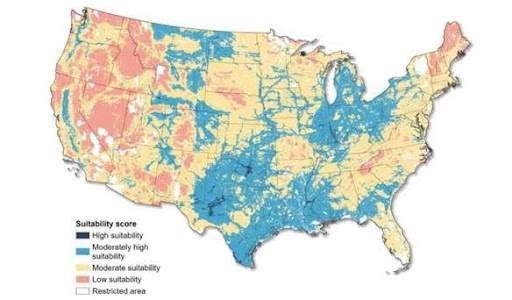
The Atlas of Natural Gas Power with Carbon Capture and Storage uses a national, data-driven multi-criteria decision analysis to evaluate siting conditions, including access to natural gas, CO2 storage, infrastructure, land, water, and proximity to demand.
“This kind of analysis is essential for decision makers who are navigating a rapidly changing energy landscape,” said Patrice Lahlum, vice president of Industrial Innovation and Carbon Management at GPI. “Electricity demand is rising quickly, and leaders across the public and private sectors are being asked to ensure reliability and affordability while also reducing emissions. Tools like this help identify where carbon management can be deployed most effectively, grounding those decisions in data, infrastructure realities, and community context.”
The atlas includes multiple scenarios that prioritise different aspects of a project based on what is most important to the developers and communities involved. The analysis identifies extensive areas of moderate to high suitability, particularly across the Gulf Coast, West Texas, Oklahoma, and parts of the Midwest, including approximately 54,000 km2 of highly suitable land and 2.3 million km2 of moderately high suitability. According to the study, these results underscore the importance of prioritising access to CO2 storage, with transport networks developed as needed to support NG + CCS deployment at scale.
While not project-specific, the atlas, which includes interactive maps, is designed as an early-stage screening tool to help policy makers, developers, and system planners focus on the most promising regions and guide more detailed evaluation and infrastructure planning.