
-
Award-winning projects push gas turbines to 100% hydrogen
Date posted:
-
-
-
Post Author
Greg Kelsall
-
-
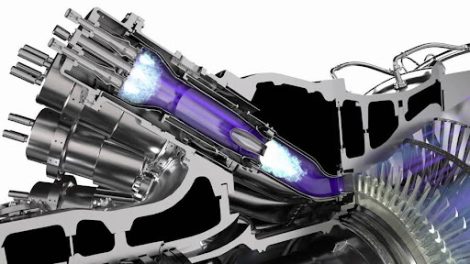
Sequential combustion system- credit: Ansaldo Energia
As reported recently by Enlit, HELIOS and FLEX4H2 jointly received the Best Success Story Award for their advances in hydrogen combustion technology last Autumn. The award was presented at Clean Hydrogen Partnership’s Hydrogen Research and Innovation Days 2025, an event geared towards mapping the sector’s key priorities for the next decade.
One of those priorities is developing advanced combustor technologies capable of operating with 100% renewable hydrogen in modern gas turbines. Hydrogen is a highly reactive fuel with laminar flame speed an order of magnitude higher than for natural gas, creating challenges for combustion systems. Maintaining flame stability, preventing flashback, and controlling emissions at high pressure are all critical hurdles that FLEX4H2 and HELIOS are working to overcome.
As summarised in the Clean Hydrogen Partnership publicity brochure, HELIOS has developed a retrofittable hydrogen gas turbine based on the FlameSheet platform, achieving fully hydrogen-powered operation, and FLEX4H2 has designed a fuel-flexible combustor capable of operating with up to 100% hydrogen blended into natural gas. Both FLEX4H2 and HELIOS follow an iterative design, test, and validation approach that moves progressively toward real-world application. Looking at the two projects in a little more detail:
FLEX4H2 is being coordinated by Italian turbine specialist Ansaldo Energia. The FLEX4H2 project builds on Ansaldo Energia’s constant pressure sequential combustion (CPSC) technology, already in use in heavy-duty gas turbines. The project has completed the design and testing of a first-generation combustor capable of operating at 100% hydrogen with a stable flame and ultra-low emissions. The design also enables smooth switching between natural gas and hydrogen, offering the fuel flexibility that operators need.
Each development cycle of the combustion system has culminated in high-pressure tests under engine-representative conditions, using detailed modelling to guide next steps, with second- and third-generation combustors to be tested at high-pressure conditions using fuel blends of up to 90% and eventually 100% hydrogen. During the final year, the project aims to demonstrate TRL 6 capability at full load using 100% hydrogen in a heavy-duty turbine.
HELIOS is working to advance Netherlands-headquartered Thomassen Energy’s FlameSheet technology, which features an aerodynamically stabilised flame and ultra-low NOx emissions. According to the Clean Hydrogen Partnership, the project has already completed high-pressure tests with 100% hydrogen and developed a quartz-glass burner model to visualise flashback events for the first time under these conditions.
It also mapped out three design and testing stages, using a combination of lab-based fundamental research, optical diagnostics, and numerical modelling to improve understanding of hydrogen flame dynamics. With each iteration, the team is refining the FlameSheet™ design to improve reliability and scalability under commercial conditions. This work will culminate in a final testing campaign using the latest design, conducted at high pressure and 100% hydrogen.
The key takeaway is that FLEX4H2 and HELIOS have demonstrated stable hydrogen combustion at high pressures, created new tools for controlling flame flashback, and laid the groundwork for gas turbine retrofits that can significantly reduce carbon intensity in the power sector.