-
Protos EfW project illustrates diversity of the UK’s carbon capture landscape
Date posted:
-
-
-
Post Author
Greg Kelsall
-
-
![]()
In a recent webinar hosted by Carbon Capture Journal as reported by Enlit, three UK-based developers outlined their carbon capture projects. These were Veri Energy, Evero and Encyclis which together illustrate the diversity and promise of the UK’s carbon capture landscape.
Last year I completed my final report for the International Centre on Sustainable Carbon (ICSC) on the global opportunity of Energy from Waste, so I was particularly interested in the third of these projects from Encyclis. With their Protos energy-from-waste (EfW) facility near Liverpool Bay forming part of the wider HyNet cluster, this project has the potential to contribute to the UK’s Greenhouse Gas Removal (GGR) ambitions to support achieving net zero emissions.
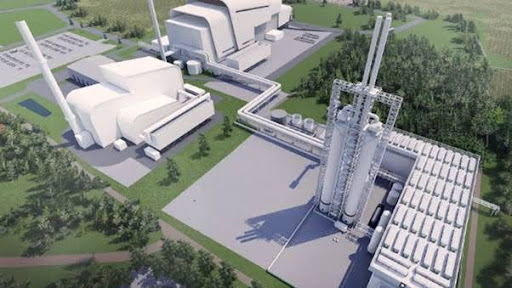
The Protos plant is currently under construction and is located close to the HyNet pipeline network near the River Mersey and Liverpool Bay. For Encyclis, carbon capture represents the key lever in delivering what the company describes as a ‘third generation’ of fully circular, fully decarbonised EfW projects.
EfW facilities typically emit around one tonne of CO₂ for every tonne of waste combusted, with around 99% of company emissions classified as Scope 1. Approximately half of Protos’ flue gas CO₂ is biogenic, providing the opportunity for significant GGR alongside emissions reductions.
The project will use amine-based absorption technology, designed to capture around 95% of the CO₂ in the flue gas. With the plant expected to operate 95% of the time, this delivers a net capture rate of around 90%. The captured CO₂ will be transported via the nearby HyNet infrastructure for direct injection and storage in depleted gas fields in Liverpool Bay.
Carbon capture is energy intensive, particularly due to the heat required to regenerate the solvent. However, as an energy generator, the EfW facility can internally supply this energy at wholesale prices, improving project economics and reducing exposure to retail power price volatility.
The project has secured planning permission, land, and an environmental permit from the Environment Agency. After two and a half years of negotiation with the UK Government, Encyclis has also established an investable subsidy and risk-sharing framework aligned with government policy objectives.
From 2029, the project aims to capture around 370 ktCO₂/y. Of this, approximately 185 ktCO₂/y would qualify as carbon removals due to the biogenic content of the waste.