-
GCCSI explores role of CCS to decarbonise cement
Date posted:
-
-
-
Post Author
Greg Kelsall
-
-
![]()
As part of an industry-focused series, the Global CCS Institute (GCCSI) is exploring the role of carbon capture and storage (CCS) in decarbonising the cement industry, one of the most essential yet emissions-intensive sectors globally.
Drawing on expert insights, project developments, and regional perspectives, this series provides a view on how CCS can support emissions reductions, focusing on its role in advancing decarbonisation efforts in cement.
The series aims to bring together expert perspectives and practical insights through:
- Factsheets – including deep dives on groundbreaking projects
• Webinars – Bringing together experts to unpack key topics and answer your questions
• Thought Leadership – Reports examining regional dynamics and decarbonisation pathways
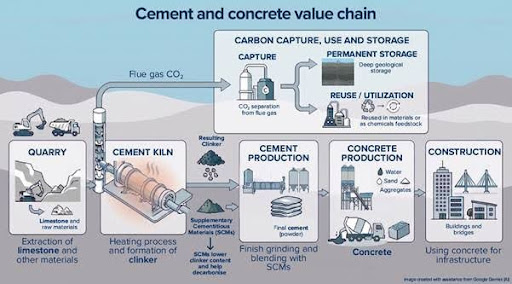
The first article released in the series is a factsheet entitled CCS with Cement – The Basics. In this, the GCCSI highlights that cement underpins modern life, particularly as it relates to the development of safe and resilient infrastructure, yet it’s responsible for around 8% of global CO₂ emissions. Unlike many other industrial sectors, cement emissions are not driven solely by energy use. Around two‑thirds of cement CO₂ emissions come from process chemistry, when limestone (calcium carbonate) is heated to produce clinker, releasing CO₂ as an inherent part of the reaction. This means that even if a kiln maximises its use of renewable energy, a large share of its emissions remains unavoidable unless CO₂ is captured and permanently stored in geologic formations. In some cases, at a smaller scale, captured CO₂ can be reintegrated into the value chain in concrete and construction materials.
CCS projects are already operating in the cement sector, and several more have been announced globally. The projects listed illustrate the feasibility of CCS and growing commercial deployment in the cement industry:
- Brevik CCS, Heidelberg Materials (Norway): capturing 400 ktCO2/y
- Qingzhou Oxy-Fuel Combustion Carbon Capture Project, China United Cement (China): capturing 200 ktCO2/y
- BBMG Beijing Cement Environmental Technology (China): capturing 100 ktCO2/y
- Padeswood CCS, Heidelberg Materials (UK): Planned to capture 800 ktCO2/y
The GCCSI has also announced a short webinar on 27 May 2026 examining the critical role of CCS in reducing emissions from the cement sector. The webinar will explore how CCS is currently being applied in cement production, what conditions are needed to scale deployment, including policy frameworks, infrastructure development, and credible business cases.
- Factsheets – including deep dives on groundbreaking projects