
-
New study from Imperial College maps the build-out needed for CCS and DAC
Date posted:
-
-
-
Post Author
Greg Kelsall
-
-
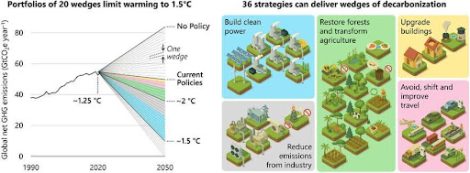
Carbon capture is often debated as a yes-or-no proposition. A new peer-reviewed study published in Science, summarised in the Carbon Capture Journal, argues the more practical question is ‘how much, and alongside what else?’.
The study quantifies how much carbon capture and storage (CCS) and direct air capture (DAC) deployment must scale up in the next 30 years to catch up with other decarbonisation options.
It uses a simple unit called the ‘wedge’, where one wedge means scaling a strategy from today so that it saves 2 BtCO2/y in 2050. For the world to limit warming to 1.5°C in the long run, 20 wedges must be deployed. While there are many options available across technology, nature, and changing people’s behaviour, the study highlights how various CCS technologies are a central part of deep decarbonisation pathways.
The study does not try to pick winners, but instead attempts to make scale comparable across very different options, in terms that can be communicated beyond specialist audiences.
For CCS in the power sector, the wedge translation is stark. One wedge from coal power with CCS would mean retrofitting around 400 GW of baseload capacity by 2050, meaning 13 large power stations each year. Achieving one wedge from gas power with CCS is more challenging still, at around 1 TW in 2050, or about 33 large stations retrofitted each year.
In contrast, bioenergy carbon capture and storage (BECCS) power plants, which actively remove CO2 from the atmosphere, require 240 GW of capacity for a wedge, meaning roughly 8 GW must be built each year until then. However, the paper contrasts these efforts with today’s starting point, where only three commercial CCS power plants are reported to be operating.
In industry, the same wedge unit sets the context for market share required. A wedge of CCS in the cement industry implies using CCS to produce about 5 billion tonnes of cement in 2050, equal to 93% of projected global supply. That’s equivalent to fitting CCS to around 30 large cement plants per year. A steel wedge equates to decarbonising 1.3 billion tonnes of steel in 2050, meaning around 39% of global supply, using CCS or hydrogen and electric routes. This pace requires six large integrated steel mills to be converted each year.
Dr Nathan Johnson of Imperial College, London said, “Sometimes it is hard to imagine the scale-up that we require to hit decarbonisation targets, so the wedge framework gives people a clear way to explain what ‘scale’ means in practice, and why project pipelines need to grow quickly.”
The study places carbon capture inside a wider portfolio. Their framework spans 36 mitigation strategies, from electric cars to reducing meat consumption, and finds many possible mixes that deliver the needed wedges. Dr Iain Staffell of Imperial College said, “Not every wedge is equally easy to deploy, and some will face cost or acceptability problems… but there are trillions of workable mixes.”
For CCUS developers, the practical takeaway is this new approach turns abstract targets into clear build rates, market shares and electricity requirements. That makes it easier to explain the value of CCS and DAC within whole-economy portfolios, and to communicate the pace of project development implied by climate goals.