-
Experimental study of particle velocity fields and gas-phase temperatures in oxy-fuel biomass combustion in a semi-industrial swirl-stabilised combustion chamber
Date posted:
-
-
Post Author
Tracey Biller
-
![]()
Combustion of biomass in existing coal-fired power plants is a promising near-term option for reducing greenhouse gas emissions—particularly when combined with oxy-fuel combustion and subsequent carbon capture and storage (CCS).
However, the scale-up of biomass oxy-fuel technology is hampered by the lack of high-fidelity experimental data from combustion chambers of industrially relevant thermal loads. In large-scale facilities, the application of advanced diagnostics is often restricted by limited optical access and harsh conditions, which is why many previous studies rely on conventional probe-based measurements.
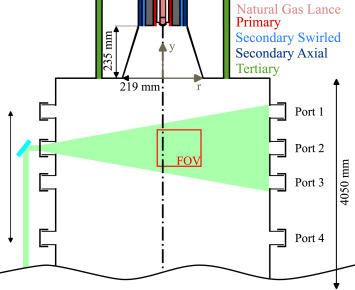
Published in Fuel, a new study demonstrates the successful transfer of planar particle tracking velocimetry (PTV) and direct tunable diode laser absorption spectroscopy (TDLAS) to a semi-industrial combustion chamber.
In the study, experiments were conducted for air- and oxy-fuel atmospheres with oxygen volume fractions ranging from 27 % to 33 %, each under two swirl settings. PTV measurements delivered two-dimensional fields of the solid fuel particle velocities, while TDLAS provided information on gas-phase temperatures along several beam paths.
The data presented in this work are the first of their kind for a semi-industrial biomass combustor, as comparable datasets were previously limited to laboratory-scale, optically accessible systems.
The results indicate that the global particle velocity field and particle distribution are governed primarily by the swirl, with oxygen fraction causing secondary effects. For both swirl settings, the oxy-fuel case at 33 % O2 most closely matched the corresponding air-fired particle velocity field. TDLAS measurements captured swirl-dependent temperature patterns.
The acquired data provide a valuable basis for the validation of numerical simulations and for the design and optimisation of future combustors.