
-
The influence of MILD-to-flame transition on stabilisation, reactive structures, and emissions of NH3/H2mixtures in a semi-industrial furnace
Date posted:
-
-
Post Author
Tracey Biller
-
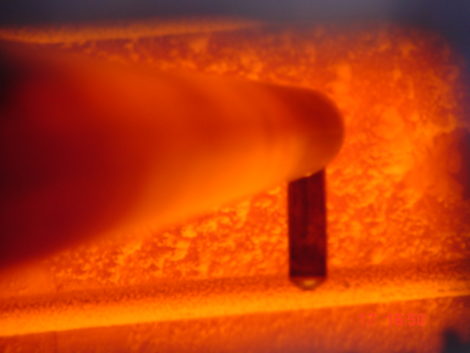
Ammonia (NH₃) is a promising carbon-free fuel for decarbonising energy systems, but its use in practical combustion systems is hindered by low flame stability and NOₓ emissions. Moderate or intense Low-Oxygen Dilution (MILD) combustion offers a pathway to suppress NOₓ through distributed reaction zones and reduced peak temperatures.
A recent study conducted at the Université Libre de Bruxelles aimed to stabilise pure NH₃ and characterise it with the addition of H₂ in a semi-industrial reverse-flow furnace under MILD conditions.
The experiments demonstrated the stabilisation of pure NH₃ under MILD conditions without reactive enhancers, resulting in negligible NOₓ emissions but significant NH₃ slip.
The impact of adding H₂ was assessed by analysing how the transition from MILD to flame influences emissions.
A transition from MILD to a lifted flame occurred at ∼14 % H₂, marked by a sharp rise in NOₓ and a steep decline in NH₃ slip. An optimal trade-off was observed at 12 % H₂, where NH₃ slip decreased from 2626 to 1336 ppm, accompanied by only a 12 ppm increase in NO, while maintaining MILD conditions. Decreasing the furnace temperature extended MILD combustion to 20 % H₂, but compared to the 12 % H₂, it caused higher NH₃ slip and only a slight reduction in NO, highlighting a trade-off between temperature control and NH₃ decomposition.
The experimental findings were analysed from a chemical kinetic viewpoint using a chemical reactor network approach. The results showed that NO reduction at H2≤20 % was dominated by thermal DeNOx, while NO formation at H₂≤80 % primarily originated from fuel-bound nitrogen.
These findings advance the understanding of NH₃-H₂ MILD combustion at realistic scales and provide insight into the design of low-emission ammonia-based systems.