-
EU revises carbon market rules
Date posted:
-
-
Post Author
Tracey Biller
-
![]()
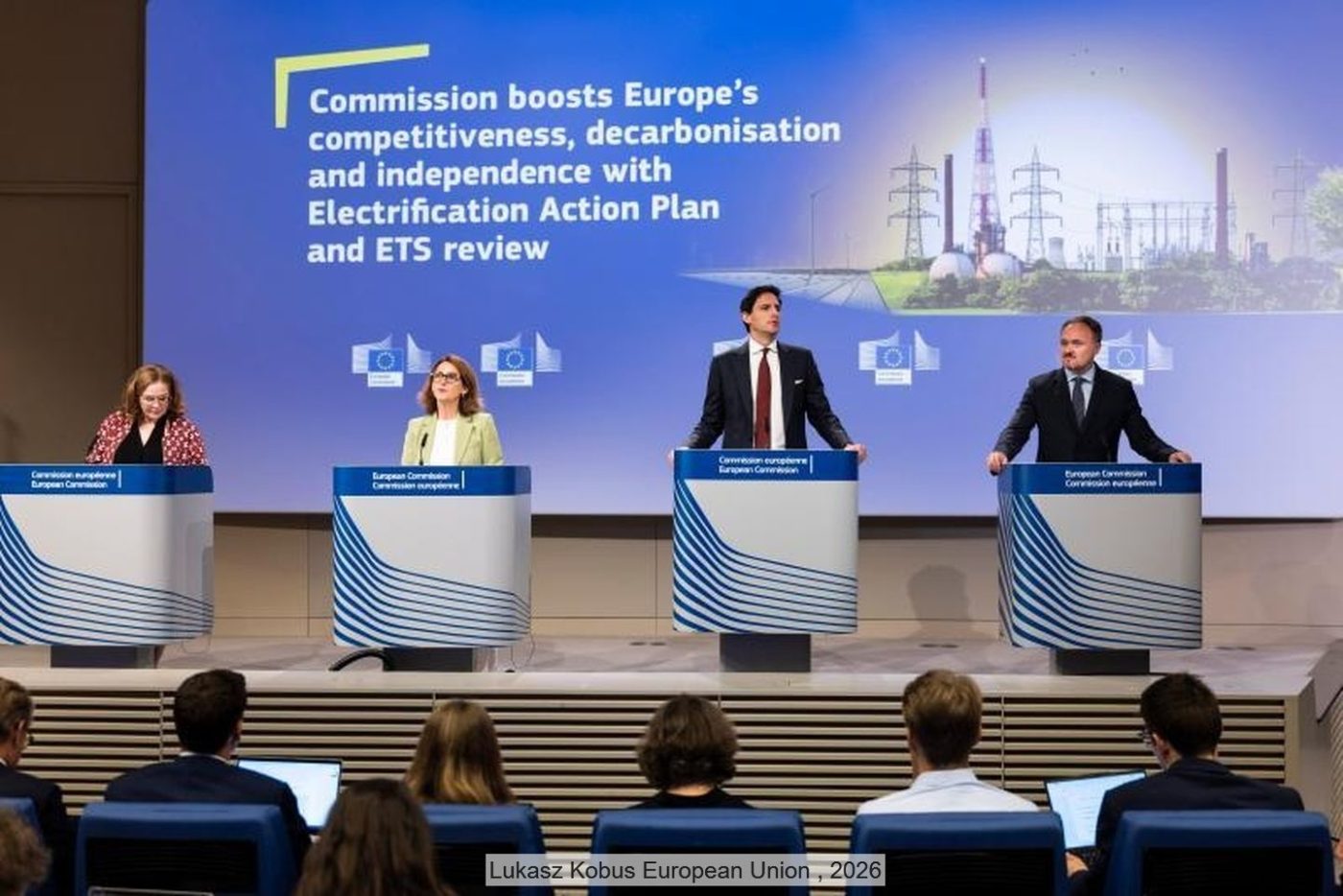
The European Commission has released the proposed revision to the EU Emissions Trading System, the EU’s flagship climate policy and one of its most consequential regulatory frameworks for business.
The controversial legislative overhaul proposes that industries be permitted to emit more CO2 for longer than previously planned. At the same time, it offers more financial support to invest in clean technologies in Europe.
According to Politico, the 20-year-old ETS, which obliges companies to pay for every ton of carbon dioxide they emit, has been “enormously successful, slashing emissions from factories and power plants by half over its lifetime.”
Under current rules, emissions from the industrial sectors covered by the ETS must reach zero by 2039. In terms of the new proposal, the zero target will be delayed well into the 2040s. This will be achieved by delaying the “linear reduction factor” (LRF) — the rate at which pollution caps fall annually, from 4.4 percent to 3.7 percent between 2031 and 2035. After 2036, it will decrease at the rate of 1.7 percent annually.
The Commission will also distribute free carbon allowances for several years longer, including to sectors covered by the carbon border tax, which will now receive them until 2038. From 2036, industry will be offered the option of buying carbon credits from outside the EU to offset their emissions. This could lower the carbon price and give industries other alternatives should EU carbon allowances be exhausted.
Politico says the final proposal “represents a significant watering down of ambition and is likely to spark a fight in Parliament and among member countries between those who want more concessions for industry, and those who want to accelerate the path to climate neutrality.” In a separate article, the publication quotes Swedish Climate and Environment Minister Romina Pourmokhtari as saying her government will “fight tooth and nail against this weakening of the framework.”
The Commission’s proposal initiates the ordinary legislative procedure, through which the three main EU decision-making bodies – the Commission, the Parliament and the Council – would need to agree on a final text. EU leadership aims to reach agreement on the reform by the end of the first quarter of 2027.