
-
Paper: Development of a Full-Scale Retrofittable Ammonia Combustor for Can Annular Frame Engine Implementation
Date posted:
-
-
Post Author
Tracey Biller
-
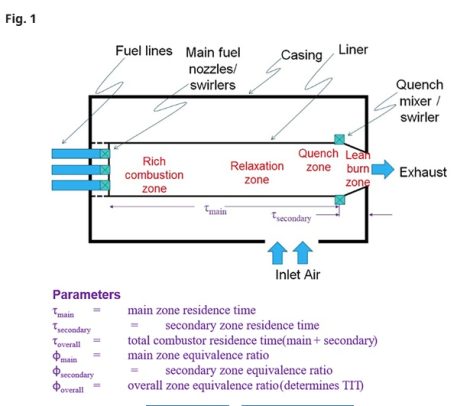
Low carbon and renewable fuels are an active area of research due to their potential to reduce both stack and life-cycle carbon emissions. Ammonia is one such fuel as it has storage, production, infrastructure, and zero carbon emissions advantages over other fuels. Its challenges include its toxicity, its combustion characteristics, and its pollutant emissions.
A paper recently published in the Journal of Engineering for Gas Turbines and Power, describes a study conducted by a team from the Georgia Tech Combustion Lab and EFRI in which researchers developed an ammonia combustor design based on technology the research team had been investigating, and retrofittable to heavy-duty power generation gas turbines in use today.
When initial scaled testing demonstrated that the rich relax quench lean (RRQL) combustor reduced NOx emissions to levels like that of natural gas, the authors designed a full-scale combustor to be tested in 2025 in the single can test rig at the KEPRI combustion lab in Daejeon, South Korea.
To accelerate learnings on the system’s design, a scaled version of the same combustor design was also built. Testing of the scaled combustor was completed at the Georgia Tech Combustion Lab in Atlanta, GA.
Scaled testing has shown great promise in NOx emissions, flame stability, fuel flexibility with blends of natural gas, and ignition capability. Full-scale and subscale combustor design development, testing, results, and future plans are all discussed.
In June 2026 at the 2026 Turbo Expo conference in Milan Italy, the research team received the award for the best paper from the Electric Power Committee for the 2025 conference version of the paper.